
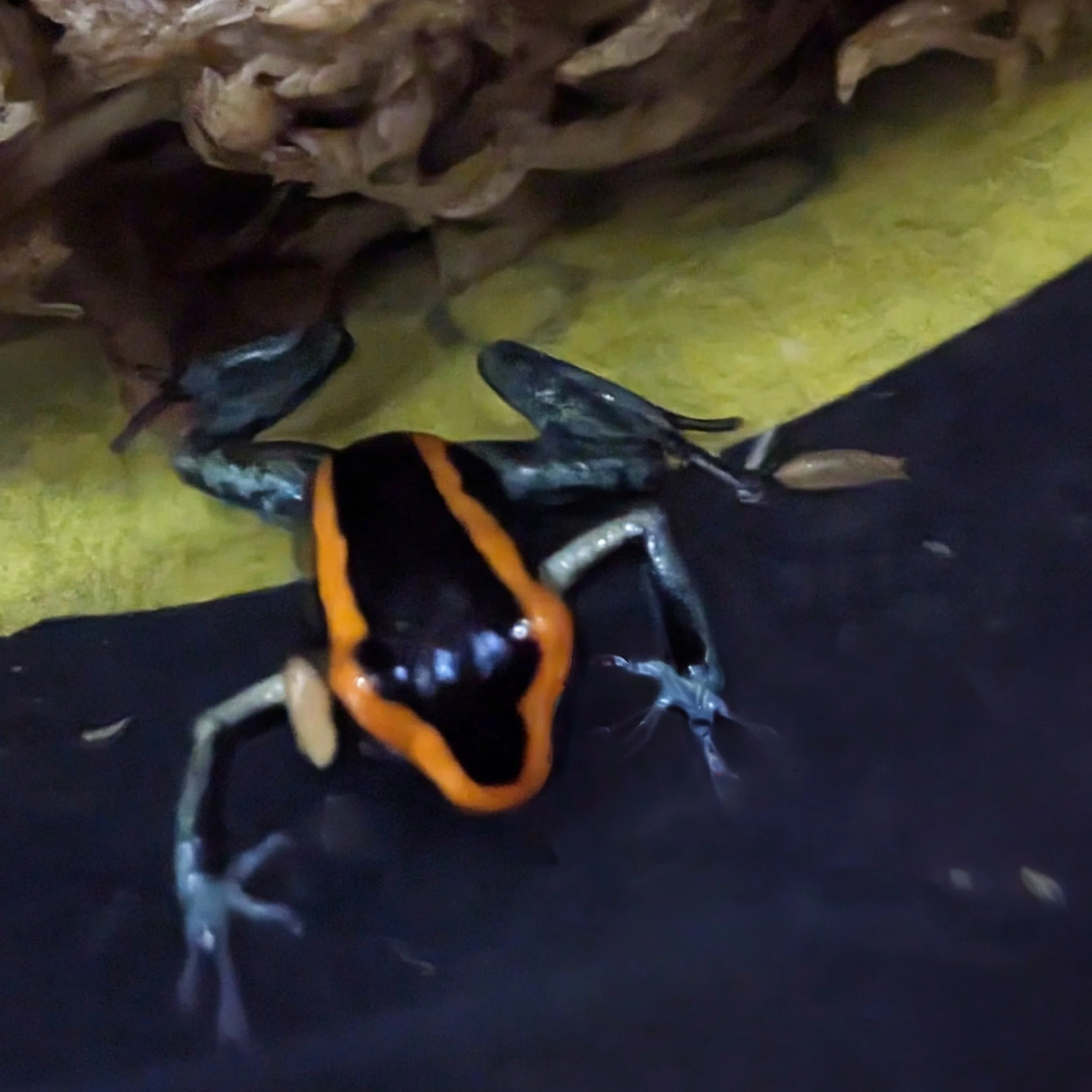
Golfodulcean poison dart frog
Phyllobates vittatus
Phyllobates vittatus is a striking poison dart frog native to Costa Rica and western Panama, best known for its bold black body with bright yellow striping and its place in the highly toxic Phyllobates genus.
🐸 Quick Facts
Family: Dendrobatidae
Size: ~2.5–3.5 cm (1–1.4 in)
Lifespan: 5–10+ years (longer in captivity)
Activity: Diurnal (day-active)
Toxicity: Yes (very toxic in the wild)
🌿 Habitat & Range
Lowland and premontane rainforests
Often found in leaf litter near streams
Elevation: roughly 20–550 m
Native to the Golfo Dulce region of Costa Rica and parts of Panama
🎨 Appearance
Glossy black base color
Two bright yellow or yellow-orange dorsolateral stripes
Smooth skin, slender body
Females are typically slightly larger than males
☠️ Toxicity (Important!)
In the wild, P. vittatus carries potent alkaloid toxins derived from its diet (ants, mites).
In captivity, they are non-toxic because captive diets lack these alkaloids.
Despite this, they should never be handled unnecessarily.
🐜 Diet
Wild: Ants, mites, small arthropods
Captivity:
Flightless fruit flies
Springtails
Pinhead crickets
Isopods (occasionally)
💚 Behavior
Active and bold during daylight
Males produce soft buzzing or trilling calls
Territorial but not overly aggressive
Excellent climbers despite being leaf-litter oriented
🥚 Reproduction
Eggs laid on moist leaves or hidden surfaces
Males often guard eggs
Tadpoles are transported to small pools or water-filled leaf axils
Tadpoles are carnivorous
🛡️ Conservation Status
IUCN: Near Threatened
Threats:
Habitat loss (deforestation)
Illegal pet trade (historically)
Protected in parts of its native range
🧪 Fun Fact
The Phyllobates genus includes some of the most toxic vertebrates on Earth—related species were historically used by Indigenous peoples for poisoning blowgun darts.